Prague Travel Guide: The Ultimate First-Timer’s Itinerary
Prague hits differently from most European capitals. The Gothic spires, the cobblestone alleyways, the Vltava River bending through the city like it owns the place. First-timers often arrive expecting a postcard and leave having experienced something far more layered. This guide cuts through the noise and gives you a practical, day-by-day framework to make the most of your first visit.
How Long Do You Actually Need?
Three full days is the sweet spot. Four is better. Two days will leave you rushed and regretful. Prague rewards slow walking and spontaneous detours, so build in margin.
If you fly into Vaclav Havel Airport, the cheapest option to the city center is Bus 119 to Dejvicka metro station, then the green line (Line A) into the center. Total cost: around 40 CZK (roughly $1.80). A licensed taxi or rideshare runs 400 to 700 CZK depending on traffic.
Day 1: The Old Town and Charles Bridge
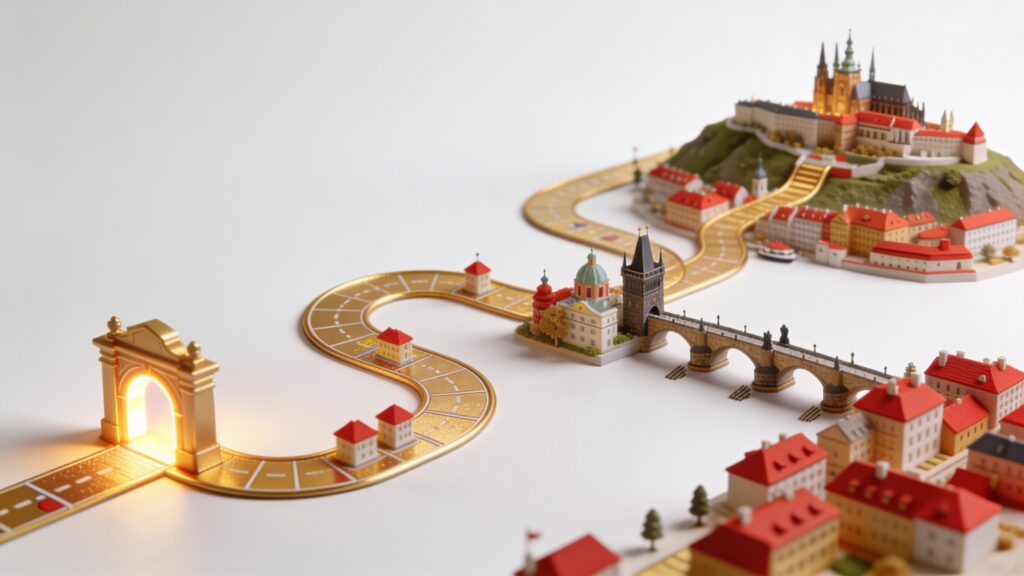
Start your first morning in Stare Mesto, the Old Town. Get to Old Town Square before 9 a.m. The Astronomical Clock (Orloj) draws crowds by mid-morning, and you want to see it on your own terms. The clock performs an hourly show with moving figures. It is genuinely theatrical, not a tourist gimmick.
From the square, walk toward Charles Bridge. Cross it on foot and take your time. The bridge has 30 Baroque statues lining both sides, and the view of Prague Castle from the midpoint is the single best free photo you will take on this trip.
What to Skip on Day 1
The horse-drawn carriage rides around Old Town Square are overpriced and congested. The area has enough to offer on foot. Skip those, keep your money, and spend it on lunch instead.
For lunch, head to Lokál on Dlouha Street. It pours Pilsner Urquell from a tank and does honest Czech food. Svíčková (beef in cream sauce with bread dumplings) is the order. Budget around 300 to 450 CZK for a full meal with a beer.
Day 2: Prague Castle and Mala Strana
Prague Castle is the largest ancient castle complex in the world by area. Clear your whole morning for it. Entry to the outer grounds is free. A Short Visit ticket (around 250 CZK) covers St. Vitus Cathedral, the Old Royal Palace, and St. George’s Basilica. That is the right ticket for a first-timer.
St. Vitus Cathedral alone justifies the detour. The stained glass windows inside, designed in part by Alfons Mucha, are extraordinary. Stand in the nave and look up. Few spaces in Europe match it.
After the castle, walk downhill into Mala Strana, the Lesser Town. This neighborhood has the atmosphere many tourists chase in Old Town but actually find in shorter supply. The streets are quieter, the architecture is dense with Baroque detail, and Cafe Savoy on Vitezna Street is a perfect afternoon stop.
Day 3: Vinohrady, Zizkov, and Local Prague
On day three, leave the tourist circuit entirely. Take the metro to Namesti Miru and spend your morning in Vinohrady. This is where Prague’s residential elegance shows. Wide tree-lined streets, Art Nouveau apartment buildings, good coffee shops, and the Church of St. Ludmila anchoring the main square.
Walk or tram from Vinohrady into Zizkov. It is rougher around the edges, historically working-class, and has more bars per capita than almost any neighborhood in Europe. The Zizkov Television Tower is polarizing in terms of design, but the view from the observation deck at 93 meters is worth the 250 CZK ticket.
For dinner, eat somewhere in Vinohrady rather than returning to Old Town. Eska on Pernerova Street is outstanding if you want modern Czech cooking. Reservations are worth making in advance.
Getting Around Prague
| Transport Option | Best Used For | Approximate Cost |
|---|---|---|
| Metro (Lines A, B, C) | Cross-city travel | 30 CZK per ride |
| Tram | Neighborhoods, sightseeing routes | 30 CZK per ride |
| 24-hour pass | Full days of exploring | 120 CZK |
| Taxi/rideshare | Late nights, airport | 200 to 700 CZK |
| Walking | Old Town, Mala Strana, Vinohrady | Free |
The tram network is excellent and I use it constantly. Tram 22 runs from the center up to Prague Castle and through Mala Strana. It is one of the best urban tram routes in Europe.
Practical Things First-Timers Get Wrong
- Currency exchange: Use an ATM from a major bank. Avoid exchange offices on Wenceslas Square. They charge punishing rates.
- Tipping: Round up or add 10 percent in restaurants. Leaving coins on the table reads as dismissive.
- Credit cards: Most restaurants and shops now accept cards, but carry some cash for smaller cafes, market stalls, and public toilets.
- Opening hours: Many museums close on Mondays. Check before you go.
- Language: Czech is the official language. Locals appreciate even a basic “Dekuji” (thank you). English is widely spoken in the center.
Best Time to Visit
Spring (April to May) and early autumn (September to October) are the ideal windows. The weather is mild, the crowds are manageable, and the city looks its best. July and August bring heavy tourist traffic and heat. December has the Christmas markets, which are beautiful but extremely crowded around Old Town Square.
Key Takeaways and Next Steps
Prague rewards preparation but punishes over-scheduling. Three days with a loose framework gets you further than a packed itinerary. The old center is spectacular, and it is also easy to see in a day and a half. Spend at least half your time in neighborhoods like Vinohrady, Zizkov, and Holesovice, where the city breathes differently.
Book accommodation in Mala Strana or Vinohrady if your budget allows. Staying in Old Town is convenient, and hotels there tend to be overpriced relative to the value.
Most importantly, walk more than you plan to. The best moments in Prague happen between the landmarks.