Group Tourism Trends in Prague: Market Evolution and Future Outlook
Prague has spent the last two decades cementing itself as one of Europe’s most visited cities. The numbers back this up. Before the 2020 disruption, the Czech capital welcomed over 8 million overnight visitors annually, with group travel accounting for a significant slice of that figure. The city’s combination of medieval architecture, world-class beer culture, affordable pricing relative to Western Europe, and a compact, walkable Old Town makes it a natural magnet for organized group trips.
What’s changed is the composition of those groups, their expectations, and the way tour operators are responding. The market has matured, and understanding where it’s heading matters for anyone working in Prague’s hospitality and tourism sector.
How the Group Tourism Market Has Shifted
The Decline of the Generic City Break
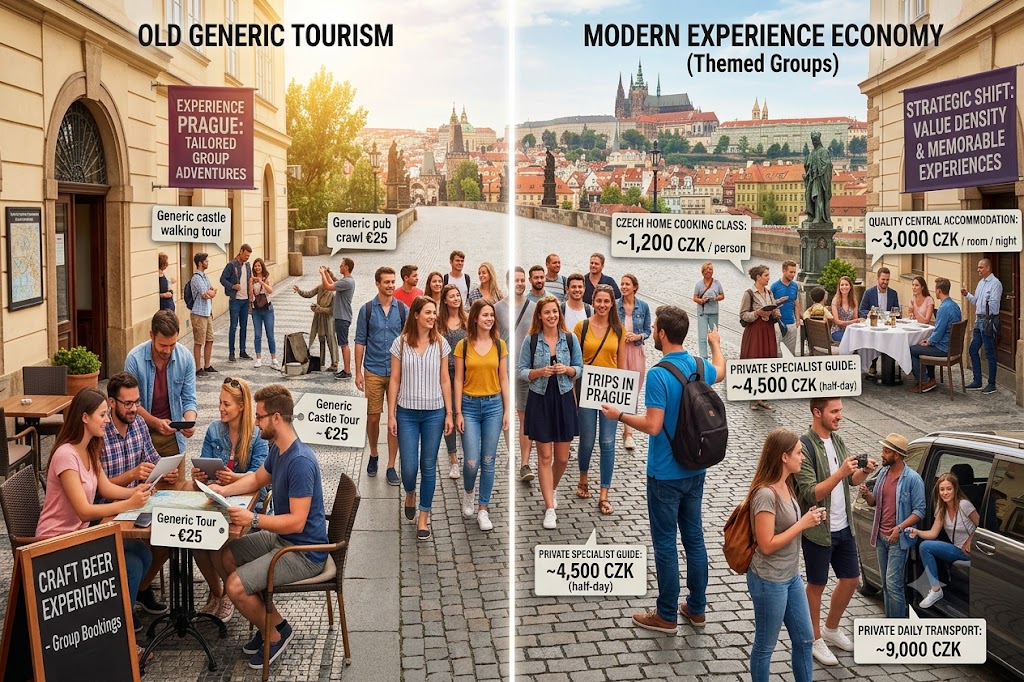
Ten years ago, a typical group booking to Prague meant a budget airline, a three-night stay, a castle tour, and a beer tasting. That template still exists, but it’s losing ground fast. Today’s group organizers, whether they’re coordinating corporate retreats, bachelor weekends, or social travel clubs, want something more tailored.
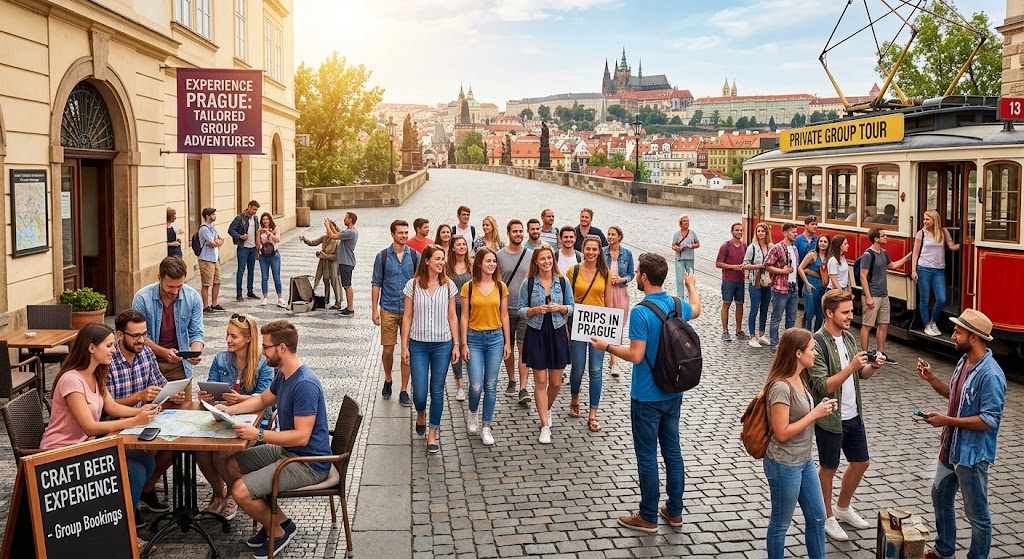
The shift is from volume to experience. Groups arriving in Prague now arrive with specific agendas. They want a private cooking class in a Czech home kitchen, a guided walk through Žižkov with a local historian, or a curated pub crawl that skips the tourist traps. Generic itineraries are harder to sell. Operators who can build a coherent, themed experience around a group’s identity are winning the business.
The Rise of the Experience Economy in Group Travel
This trend mirrors broader shifts in consumer behavior. People prioritize spending on experiences over physical goods, and groups amplify that instinct. When twelve people pool their budget for a shared activity, the bar for quality rises accordingly.
Prague is well positioned to capitalize on this. The city has a deep reservoir of cultural assets that translate well into group experiences. The Jewish Quarter, the Cold War-era bunkers beneath the city, the Art Nouveau interiors of the Municipal House, the craft distilleries tucked into Vinohrady, all of these offer programmable experiences that go beyond sightseeing.
Key Segments Driving Demand
The group tourism market in Prague breaks down into several distinct segments, each with its own profile and growth trajectory.
| Segment | Primary Motivation | Average Group Size | Growth Direction |
|---|---|---|---|
| Corporate retreats and incentive travel | Team building, reward trips | 15 to 50 | Strong upward |
| Bachelor and hen parties | Celebration, nightlife | 8 to 20 | Stable |
| Educational and student groups | Cultural learning | 20 to 60 | Moderate |
| Special interest tours | History, food, architecture | 10 to 25 | Upward |
| Social travel clubs | Community, shared interest | 10 to 30 | Strong upward |
Corporate and incentive travel is the standout growth segment. As companies compete for talent and invest in culture-building, Prague’s combination of high-quality venues, relative affordability compared to London or Amsterdam, and strong air connectivity from across Europe makes it a compelling choice. The city’s congress infrastructure has also improved substantially, with venues like the Prague Congress Centre upgrading their facilities to attract larger delegations.
Special interest tours are the other segment worth watching. Groups organized around food, architecture, history, or film location tourism are smaller but they spend more per head and return more often.
Pricing Dynamics and Value Positioning
Prague’s competitive advantage has always been its price-to-quality ratio. A group dinner at a mid-tier restaurant in Prague costs a fraction of what the same quality experience would run in Vienna or Paris. That gap has narrowed over the past decade as Prague’s popularity pushed prices upward, but the city remains excellent value by Western European standards.
The smart positioning for group tourism suppliers right now is to stop selling Prague purely on price and start selling it on value density. The argument should be that for the same budget, a group gets more variety, more quality, and more memorable experiences in Prague than almost anywhere else in the continent.
Here are the pricing realities group organizers should factor in when planning:
- Premium private dining for groups runs roughly 800 to 1,500 Czech crowns per person, including wine.
- Private guided tours with specialist guides average 3,000 to 6,000 crowns for a half-day regardless of group size.
- Quality accommodation for groups in central Prague ranges from 1,800 to 4,500 crowns per room per night.
- Private transportation within the city for a full day costs 5,000 to 12,000 crowns depending on vehicle type and group size.
Future Outlook: Where the Market Goes from Here
Sustainability as a Booking Criterion
Sustainability has moved from a marketing checkbox to an actual booking criterion for a growing share of group organizers. Corporate clients in particular face internal pressure to demonstrate environmental responsibility, and that scrutiny extends to travel decisions. Prague-based operators who can document their sustainability practices, local sourcing, reduced waste, carbon offset schemes, will find doors opening that were previously closed.
Technology and Personalization at Scale
Group travel coordination is notoriously admin-heavy. The platforms that solve the logistics problem well, itinerary management, payment splitting, communication tools, real-time availability for group bookings, will capture market share. Prague-based operators who invest in digital infrastructure rather than relying on email chains and PDFs will process more bookings with less friction.
The Micro-Group Trend
Average group sizes are trending downward. Micro-groups of six to twelve people are emerging as a distinct segment, sitting between individual travel and traditional group tours. These groups want the benefits of private, curated experiences but without the overhead of large-group logistics. They are willing to pay a premium, and they’re often harder to reach through traditional tour operator channels because they self-organize online.
Key Takeaways
Prague’s group tourism market is in a transition period. The old model of high-volume, low-margin, generic city breaks is giving way to something more nuanced. Experience quality, personalization, and thematic coherence are now the differentiators.
Operators who understand which segment they’re serving, price for value rather than just competing on cost, and invest in both sustainability and digital capability are the ones who will dominate the next decade of Prague group travel.
If you’re involved in organizing or supplying group experiences in Prague, the single most useful thing you can do right now is audit your current offering against the expectations of the corporate incentive and special interest segments. That’s where the growth is, and Prague has everything needed to serve it exceptionally well.